

By: Angelica Agati & Raquel Perez | Published: August 18, 2026
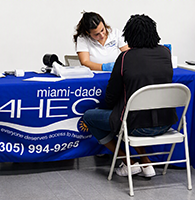
Miami-Dade Area Health Education Center staff member helps a patient.
Behind many of Florida’s advances in Community Health Worker (CHW) training is a longstanding partnership between the Miami CTSI and Miami-Dade Area Health Education Center (MD-AHEC). AHECs are community-based organizations that partner with universities and medical schools to train healthcare workers in medically underserved areas.
Building on a broader University of Miami collaboration that spans nearly four decades, the organizations have helped create training programs, support workforce development, and connect communities with critical health resources.
That impact can be seen in several milestone achievements. Early on, the collaboration helped establish Florida’s formal CHW certification through its involvement in a statewide coalition.
More recently, with support from the Patient-Centered Outcomes Research Institute (PCORI), the Miami CTSI and MD-AHEC developed a research training program that has reached 864 certified CHWs.
The program is now completed by 26% of Florida’s certified CHW workforce, and the training model has been disseminated to Texas and California.
Last year, with support from the National Institutes of Health (NIH), the CTSI and MD-AHEC expanded Community Health Workers’ ability to address social factors that contribute to adverse health outcomes.
Miami-Dade AHEC supports Community Health Workers in delivering programs and services that improve diabetes outcomes across the county.
With funding from the Florida Department of Health’s Cinotti Program, community members gain access to diabetes screenings, educational workshops, care linkages, and ongoing support.
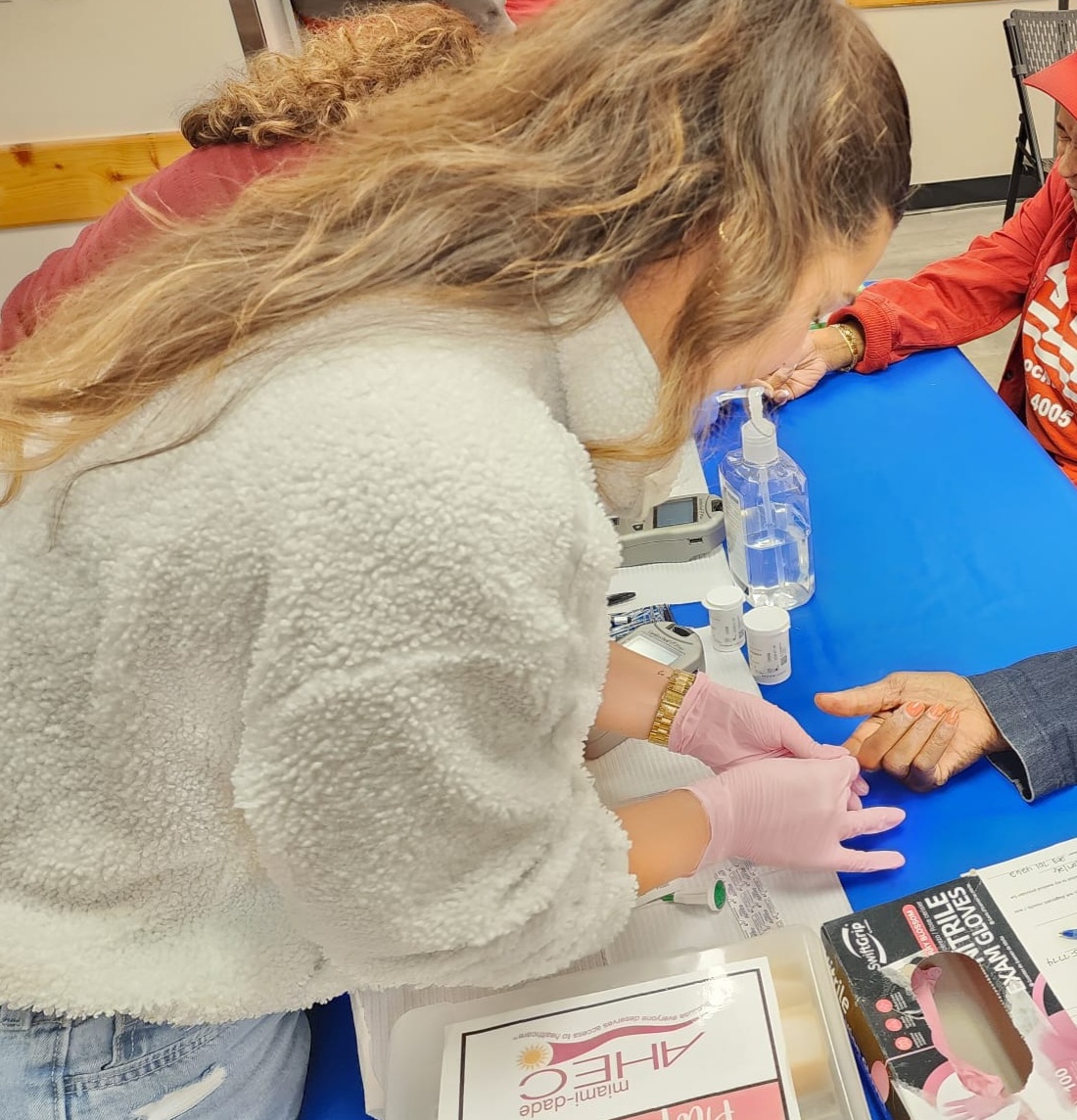
A Miami-Dade Area Health Education Center staff member conducts a diabetes screening.
Participants receive their screening results and are encouraged to share them with their healthcare providers. For those without an established source of care, Miami-Dade AHEC helps connect them with local healthcare professionals and resources.
One participant’s story highlights the importance of this approach. During a community screening, CHWs identified a resident with an A1c level above 14. They discovered she had gone without a prescribed diabetes medication because it was not covered by insurance, she could not afford it, and she was unable to reach her healthcare provider for help.
MD-AHEC’s network of community and healthcare partners helped reconnect the resident with her physician. With an appointment quickly arranged and a covered medication identified, she was able to resume treatment and receive the care she needed.
“Stories like this demonstrate the vital role CHWs play in improving health outcomes. Beyond providing services, they help individuals navigate complex healthcare systems, remove barriers to care, and build the trust necessary to ensure that no one is left behind,” said MD-AHEC Chief Executive Officer Marilyn Roman.
By serving as a bridge between communities and healthcare resources, organizations such as Miami Dade AHEC are helping create healthier futures for Miami-Dade residents.
Through its longstanding partnership with MD-AHEC, the Miami CTSI has helped build a workforce equipped not only to deliver health information and services, but also to navigate barriers to care, foster trust, and connect people with the resources they need.
To learn more about Miami-Dade AHEC, you can visit their website at www.mdahec.org.
RECENT POSTS
POPULAR TAGS
NEWSLETTER SIGNUP
If you would like to receive emails about the latest Miami CTSI events, funding opportunities, services and news, sign up to be on our mailing list.